

Japan Airlines to Trial Humanoid Robots for Baggage Handling at Haneda Airport
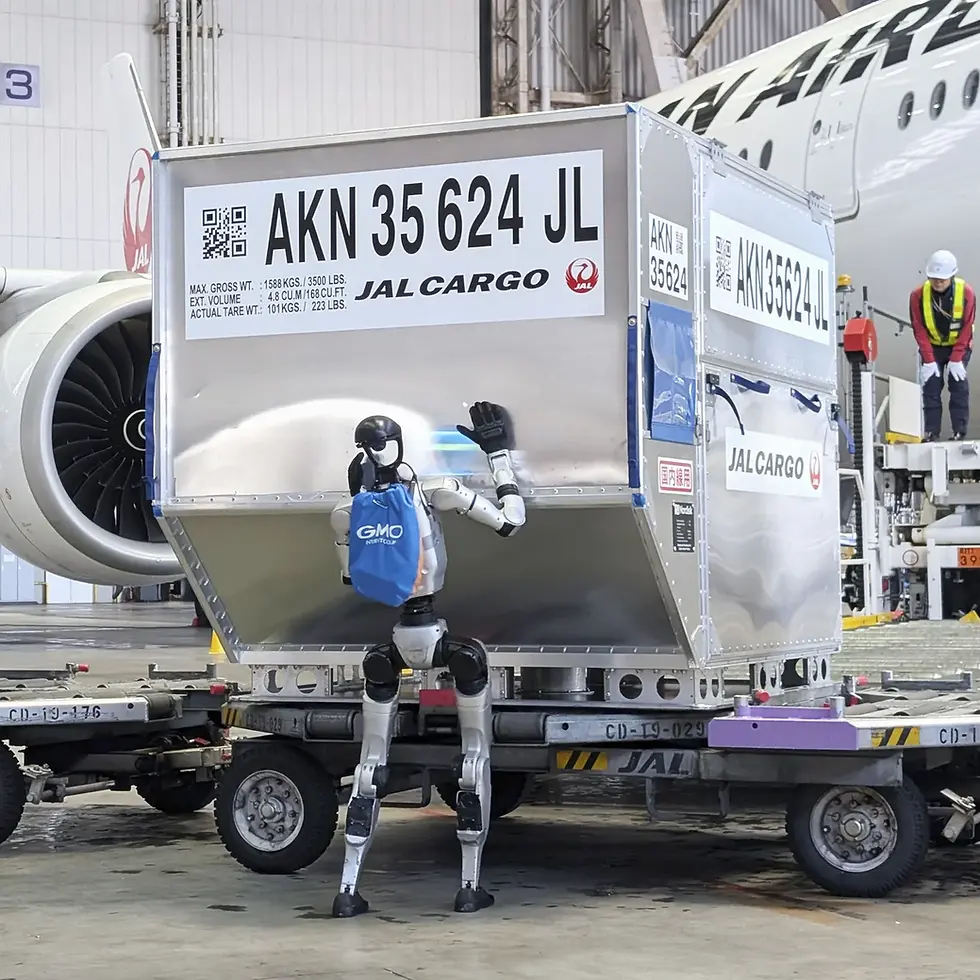
Japan Airlines is preparing to test humanoid robots as ground-handling assistants at Tokyo’s Haneda Airport, in a move that could reshape how airlines manage physically demanding airport work.
The trial is expected to begin in May 2026 and run for around two years. The robots will be used to support baggage and cargo handling tasks, helping reduce the physical strain placed on airport ground staff.
The project reflects a wider push in Japan to use robotics and automation to address labour shortages, workplace safety concerns, and the increasing pressure on airport operations.
What will the robots do?
The humanoid robots are being introduced to assist with tasks that are physically repetitive or strenuous. These may include handling baggage or cargo items, moving loads, and supporting workers in areas where lifting and carrying can cause fatigue or injury.
Rather than replacing all ground staff immediately, the trial appears focused on testing whether robots can safely work alongside human employees and reduce the physical burden of heavy manual tasks.
Ground handling is one of the more labour-intensive parts of airline operations. Workers often lift bags repeatedly, work in tight spaces, operate under time pressure, and deal with irregular schedules and weather conditions. If humanoid robots can assist in these environments, they could help make airport work safer and more sustainable.
Why Haneda Airport?
Haneda is one of Japan’s busiest airports and a major international gateway. Testing the robots there gives Japan Airlines a real-world environment with high operational demands.
A busy airport setting allows the airline to evaluate whether humanoid robots can function reliably around aircraft, baggage systems, staff, vehicles, and strict safety procedures.
The trial will likely examine:
how well robots handle baggage-related tasks
whether they reduce strain on human workers
how safely they operate near people and aircraft
whether they can work efficiently in airport conditions
how much training and supervision they require
whether the technology is practical for wider rollout
Japan has long been associated with advanced robotics, but using humanoid robots in live airport ground operations would be a major step forward. Airports around the world are already adopting automation for check-in, security screening, cleaning, and baggage systems, but humanoid robots working directly in baggage handling would be a more visible and ambitious use of the technology.
The trial also comes at a time when airlines and airports are under pressure to improve efficiency while managing staffing challenges. If successful, the robots could eventually help reduce workplace injuries, support ageing workforces, and improve consistency in physically demanding airport roles.
Are robots replacing airport workers?
For now, the focus appears to be assistance rather than full replacement.
The robots are being trialled as tools to support human workers, particularly with heavy or repetitive tasks. Human staff will still be needed for supervision, decision-making, safety checks, aircraft operations, customer service, and many parts of ground handling that require flexibility and judgement.
In the short term, the most realistic outcome is a hybrid model:
humans manage and supervise operations, while robots help with physically demanding tasks.
Japan Airlines’ trial could become an important test case for the aviation industry. If humanoid robots prove useful at Haneda, similar technology could eventually appear at other airports, especially in countries facing labour shortages or rising operational costs.
However, the trial will need to prove that the robots are not only impressive, but also practical. They must be safe, reliable, cost-effective, and able to operate within the strict timing and safety requirements of airport ground handling.
For passengers, the change may not be immediately obvious. But behind the scenes, it could mark the beginning of a new phase in airport automation.



Comments